





The Finance Operations Gap in Mid-Sized Law Firms: How Accounting Outsourcing Models Are Changing
Last updated:
27 Mar, 2026 |
6 Minutes Read

Strategic business insight, compliance rigor, and operational scalability are equally vital as traditional cost discipline
The financial operations of law firms are becoming more demanding. Between convoluted billing structures and tighter regulations, the leadership of law firms now expects the Finance and Accounting (F&A) function to provide strategic insight to drive the business. But for mid-sized firms, typically with 50-300 attorneys, this is a tall order. When billing, collections, compliance, and reporting become tangled, the impact on the firm’s resilience often remains invisible until it hits the bottom line.
In this environment, financial services outsourcing has become a routine part of law firm operations. A 2023 survey from Thomson Reuters Financial Insights found that nearly two-thirds of law firms outsource at least one role, with spending on these services increasing year-over-year. It’s a pragmatic response to a simple problem: law firms need specialist support to handle rising costs without the bloated headcount.
Why Financial Complexity is Harder to Absorb for Mid-Sized Law Firms
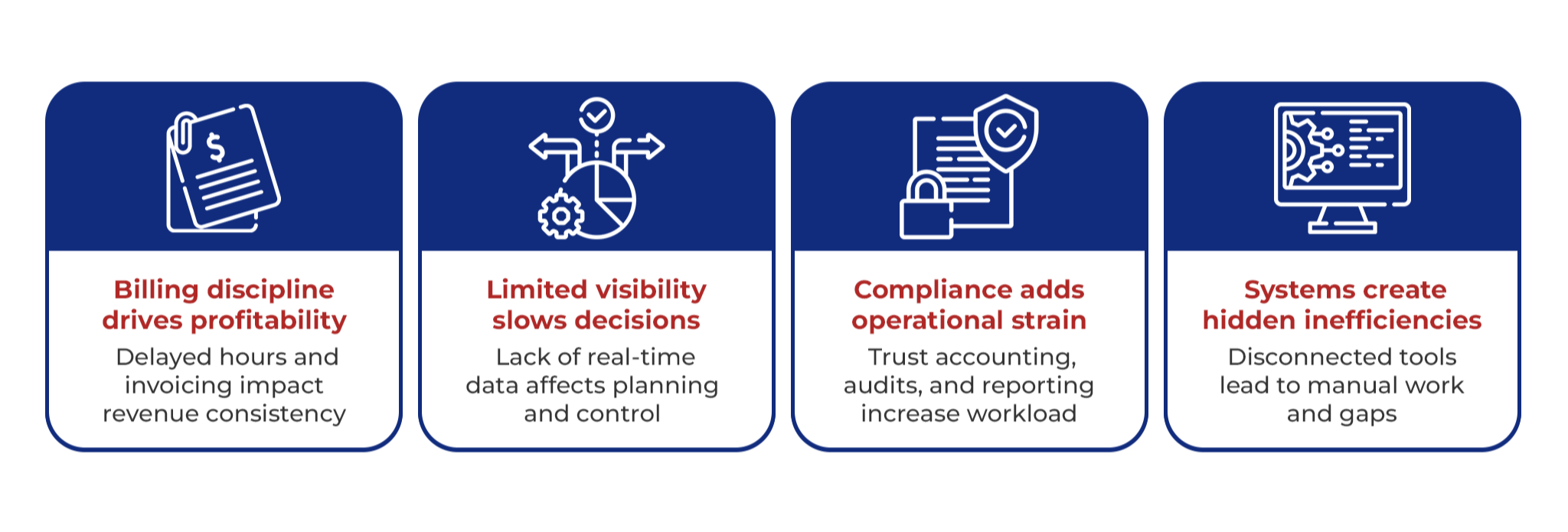
Unlike large global firms with scale and deep administrative benches, mid-size law firms operate in a narrow band. They face the same complex accounting and compliance demands, but making sustained investment in specialist talent, systems, and controls is constrained. As a result, pressure tends to build up in a few areas within the F&A function.
- Profitability is tied to billing discipline: Making consistent profits depends on how efficiently billable work is converted into revenue. That hinges on the timely submission of hours and a responsive back office that can generate accurate invoices. Here, law firms need to build out F&A teams that are familiar with the legal profession’s specialized billing formats and technologies, while also maintaining a firm’s regular accounting cycles.
- Decision-making requires continuous visibility: Focusing on key performance metrics is equally important as F&A metrics. Firms need visibility into actual results against their budgets and forecasts to assess whether the business is performing as intended. This allows issues to be identified earlier and enables timely adjustments to protect efficiency and profitability.
- Compliance adds another layer of pressure: Legal accounting systems must support strict trust accounting, audit readiness, and regulatory reporting. In practice, many firms rely on partially integrated tools and workarounds that increase manual effort while limiting visibility. Finance teams spend a significant amount of time managing exceptions and compliance tasks, leaving little capacity for analysis or forward-looking insight.
- Sustaining F&A capabilities internally is becoming inefficient: F&A teams now work across several connected systems from case management to timekeeping through to billing and financial reporting. Keeping those systems aligned takes constant attention and more than just accounting skills. Today’s market demands partners that can manage platforms, fix process gaps, and adapt as technology evolves. For a mid-sized law firm, sustaining this mix of capabilities internally becomes inefficient.
Scaling the Finance Function Requires More Than Additional Headcount
When these pressures mount, mid-sized firms face a choice: continue adding internal headcount or transition to an outsourced model. While internal hiring meets immediate needs, it often ties operational success to individual capacity. This creates a person-centric infrastructure rather than a scalable foundation, making it difficult to expand without a proportional increase in management oversight and training.
Strategic finance outsourcing, in contrast, functions as an infrastructure upgrade. By integrating a partner’s pre-built ecosystem of legal-specific technology and documented workflows, the firm’s financial intelligence is embedded into standardized, tech-enabled workflows. This creates a resilient foundation where processes from trust accounting to the Order-to-Cash (O2C) cycle operate with consistency. Rather than managing the intricacies of daily execution, the leadership can leverage the partner ecosystem to gain high-level visibility and predictable performance.
The Role of Finance Outsourcing in Improving Profitability and Compliance
For mid-sized law firms, outsourcing legal financial operations offers a way to stabilize performance while reducing the pressure on internal teams. External partners bring coordinated capability across people, processes, governance, technology, and data, allowing firms to address operational gaps without redesigning the finance function from scratch.
- Improving cash flow through billing discipline: The most immediate impact of outsourced financial services is seen in cash flow. Standardized workflows, defined ownership of the O2C cycle, and regular follow-ups reduce delays between time capture and invoicing. As billing becomes more predictable, revenue leakage decreases, and cash inflows stabilize. This improves working capital and supports more reliable financial planning at the firm level.
- Maintaining compliance through embedded controls: Trust accounting and regulatory reporting require governance that operates continuously instead of just audit intervals. Treating compliance as an episodic cleanup exercise leaves gaps where errors and exceptions can accumulate without being noticed. With finance outsourcing service models, governance is built into everyday finance operations through documented processes, clear approval mechanisms, and system-enforced routine checks. The result is better audit readiness with fewer last-minute corrections, and a finance team that spends less time fixing issues after they have occurred.
- Expanding financial insight available to leadership: When routine finance activities are handled externally, internal finance leaders gain time to focus on analysis and interpretation. This enables closer examination of profitability, pricing patterns, cost drivers, and margin performance. Over time, financial information becomes more usable and timely, supporting better-informed decisions across the partnership.
- Supporting variable demand without fixed cost expansion: Legal workloads fluctuate in response to client activity, litigation cycles, and regulatory change. Outsourced finance models accommodate this variability by adjusting capacity as needed. This flexibility limits the need for permanent staffing changes and reduces disruption during periods of growth or contraction, helping firms maintain operational balance.
- Bringing integrated capability into the finance function: Outsourced financial services align execution with improvement. External partners combine skilled resources, process discipline, governance frameworks, aligned technology, and structured data management. Together, these elements strengthen the finance function incrementally, improving reliability and visibility while allowing internal teams to remain focused on firm priorities.
Legal Accounting Under Evolving Demands
As financial processes grow more specialized and interconnected, gaps in coverage and delays in execution tend to surface quickly, often before firms realize where the strain is coming from.
For mid-sized law firms, this shift does not require dismantling internal expertise but strengthening it. When accounting work is handled by teams with legal-specific expertise and clear process ownership, billing cycles stabilize, compliance becomes routine rather than reactive, and financial information becomes easier to trust.
As firms grow, legacy finance infrastructure can place increasing pressure on management bandwidth. Shifting to a more system-led operating model allows scale without introducing additional complexity or control risk.
Cogneesol works with law firms to support accounting and financial operations through dedicated teams and proprietary ADIS framework that are designed around the specific requirements of the industry. To understand whether this approach aligns with your firm’s needs, contact our team for a focused discussion.