





How Composable F&A Architectures Empower the Modern CFO
Last updated:
27 Mar, 2026 |
7 Minutes Read

CFOs are expected to play a far more strategic role than in the past. Beyond running efficient finance operations, they are responsible for guiding growth decisions, managing risk in volatile conditions, supporting mergers and expansion, and delivering timely, reliable insights to boards and CEOs. This shift reflects a broader evolution in how finance leadership defines success, from operational efficiency to strategic contribution. At the same time, automation and data-driven decision-making are raising expectations for speed, accuracy, and foresight. Together, these pressures are compressing the margins that CFOs must act on while increasing the cost of delayed or uncertain insight.
Traditional Finance and Accounting (F&A) environments were built for stability rather than continuous change. Core systems such as ERP remain essential systems of record, but their monolithic design can make it difficult to adapt finance capabilities quickly as business needs evolve. A recent Gartner study indicated that by 2027, more than 70 percent of ERP initiatives will not fully meet their original business case goals, often because organizations struggle to extend rigid architectures in response to changing requirements.
This does not point to a failure of ERP itself, but to a growing mismatch between modern finance expectations and traditional system design. CFOs need ways to evolve finance capabilities without destabilizing core platforms or introducing unnecessary risk. In recent years, composable F&A architectures are emerging as the future-ready framework for finance teams. By enabling modular finance capabilities to operate around a stable ERP core, composable F&A allows CFOs to modernize incrementally, respond faster to change, and deliver greater strategic value while maintaining control, compliance, and confidence in their numbers.
What Composable F&A Actually Means
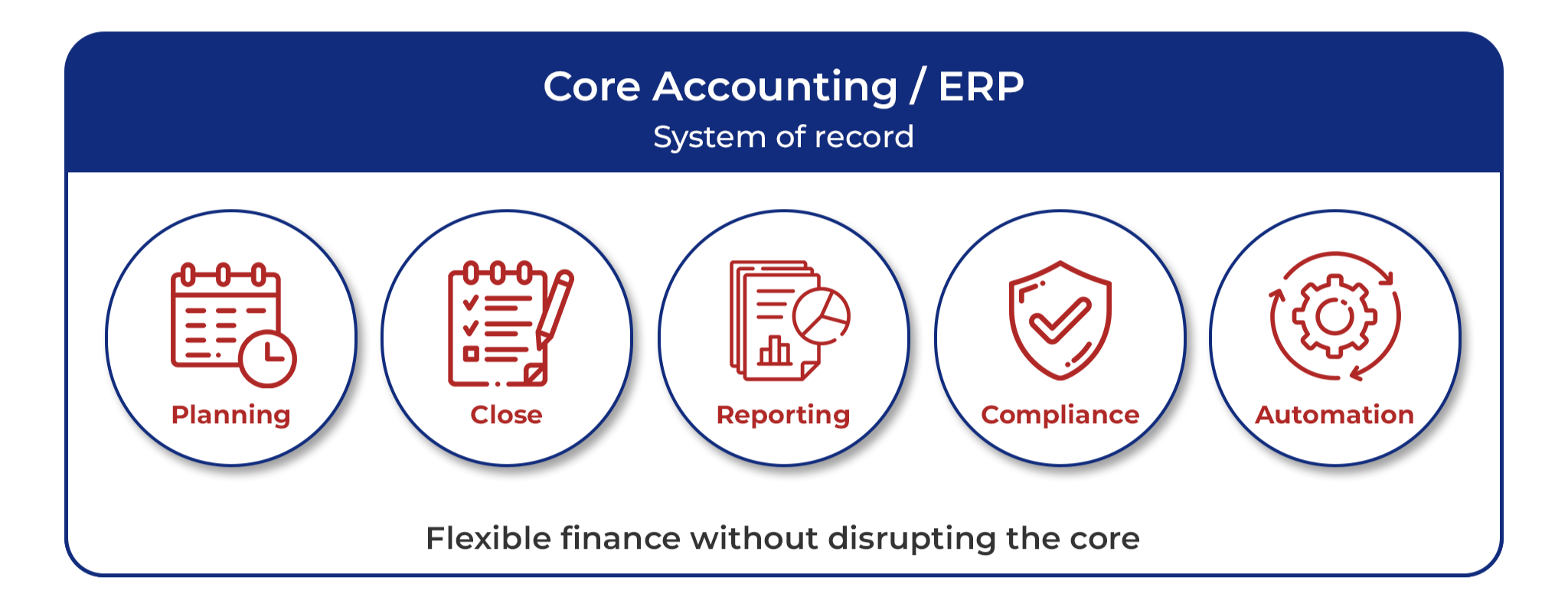
Composable F&A must not be confused with abandoning ERP systems. It is about designing finance capabilities such as close automation, reporting, planning, compliance, and analytics as modular, independently deployable components that operate around a stable ERP core. It allows finance leaders to respond to disruptions at the pace of today’s business demands, without destabilizing core systems or increasing operational risk.
For example, during post-acquisition integration or close acceleration initiatives, organizations retain ERP as the system of record for transactions, while deploying modular close automation, F&A, and reporting layers that integrate with the core through governed data and process interfaces. This enables faster insight and standardization without destabilizing underlying financial controls.
Why Traditional F&A Architectures Limit CFO Impact
Most finance organizations did not design their current environments intentionally. They evolved over time. New requirements were addressed through customization, bolt-on tools, and manual workarounds.
As a result, many CFOs face common constraints:
- Core ERP systems that remain stable systems of record but are difficult to extend, resulting in accumulated customizations and dependency on workarounds over time.
- Finance processes where 30 to 50 percent of effort is typically spent on spreadsheet-based activities, manual reconciliations, and data validation rather than analysis.
- Reporting environments that pull data from multiple disconnected systems, often requiring repeated extraction, reconciliation, and manual adjustments before results can be trusted.
- Month-end close cycles that can extend to 8 to 12 days, delaying management insight and reducing the window for proactive decision making.
These constraints directly limit the CFO’s ability to act as a strategic partner. When finance spends more time reconciling data than interpreting it, insight arrives too late to influence outcomes. Furthermore, replacing ERP entirely is rarely the answer. It is expensive, disruptive, and introduces risk.
How Composable F&A Empowers CFO Decision Making
Composable finance architectures give CFOs the freedom to make high-stakes business decisions without being constrained by rigid systems.
As forecasting accuracy and scenario planning become critical, finance leaders no longer need to modify the general ledger or rely on complex ERP customizations. In a composable model, advanced planning and forecasting capabilities operate alongside core accounting, enabling more responsive modeling while preserving financial controls.
That same flexibility becomes essential following an acquisition, when finance teams are under pressure to consolidate reporting quickly without sacrificing consistency or auditability. Composable reporting and consolidation layers can absorb new data sources without restructuring the underlying ERP, accelerating visibility across the combined organization.
Regulatory change introduces a different set of demands. As requirements evolve, CFOs can introduce new controls, validations, or reporting workflows at the process level rather than through system redesign. Governance is embedded directly into automated finance operations, strengthening compliance while reducing manual effort.
Across these scenarios, composable F&A allows CFOs to move faster with confidence, preserving financial integrity while improving the quality, transparency, and timeliness of decision-critical insight.
Integration is the Foundation of Composable Finance
Composable architecture only delivers value when integration is treated as a finance-owned capability, not simply an IT exercise. Without this ownership, modular finance becomes fragmented finance.
From a CFO perspective, integration ensures that financial data flows consistently across accounting, finance operations, analytics, and reporting. Modular components operate as a unified finance ecosystem rather than isolated tools, creating a single version of the truth that finance leaders and executive teams can rely on.
When integration is governed from within the finance function, leaders gain:
- Real-time visibility into cash flow and working capital
- Faster close cycles with fewer manual reconciliations
- Consistent performance metrics across regions and business units
- Greater confidence in forecasts and scenario analysis
Control and Compliance in a Composable Model
Any discussion of modular or composable finance immediately raises questions around auditability, regulatory exposure, and data integrity. Speed is valuable, but not if it introduces risk or weakens governance.
Composable F&A architectures address these concerns by changing how control is achieved, not by relaxing it. Instead of relying on manual reviews, spreadsheet-based checks, and after-the-fact reconciliations, governance is embedded directly into finance processes and data flows. Control becomes part of the operating model rather than an overlay.
In practice, this delivers clear, CFO-relevant advantages:
- Standardized data structures ensure consistency across entities, systems, and reporting layers, reducing interpretation risk and reconciliation effort.
- Automated controls and validations are built into workflows for close, reporting, and compliance, limiting manual intervention and human error.
- Clear, system-driven audit trails make it easier to trace transactions, approvals, and adjustments without extensive manual documentation.
- Targeted regulatory updates can be implemented at the process or workflow level, avoiding broad system changes that increase operational risk.
- Continuous risk monitoring replaces periodic, retrospective reviews, giving CFOs earlier visibility into potential issues.
For the modern CFO, composability does not dilute control. It simplifies governance, strengthens accountability, and makes compliance more sustainable as the business grows and changes.
From Efficient Finance to Strategic CFO Leadership
The cumulative impact of composable F&A is a fundamental shift in how finance creates value for the enterprise. As transactional activities become automated and standardized, CFOs can redirect time, talent, and attention toward higher-value priorities. Finance becomes more deeply involved in business partnering, capital allocation decisions, working capital optimization, performance management, and enterprise risk oversight.
With more timely and reliable data, CFOs are better positioned to evaluate investment trade-offs, assess liquidity under different operating conditions, and support leadership teams with forward-looking scenario analysis. This helps finance move beyond reporting historical performance to shaping decisions that influence growth, resilience, and return on capital.
For CFOs, the question is no longer whether finance architecture needs to change, but whether it is flexible enough to support the strategic role that finance is now expected to play.
How Cogneesol Supports Composable F&A Journeys
Composable F&A modernization requires an architecture-led approach that balances flexibility with governance.
Cogneesol’s Adaptive Digitally Intelligent Solution (ADIS) is designed as an architecture-led, governance-first framework for modernizing finance. It brings together finance domain expertise, process architecture, digital integration, and embedded analytics to support incremental evolution around existing core systems.
Connect with our experts to discuss how your finance function can evolve to meet future demands.